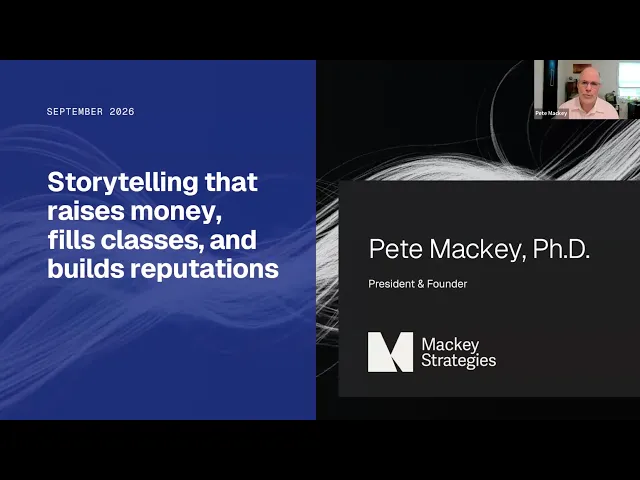
Storytelling That Raises Money, Fills Classes, and Builds Reputation
Resources for higher ed professionals across admissions, advancement, and communications.
Persuasive storytelling isn't a gift — it's a skill you can apply using a few core principles.
In this webinar, Pete Mackey unpacks why stories persuade and shares the strategies to make them work, whether you're in admissions, academic leadership, communications, fundraising, or public relations.
This session is adapted from Pete's keynote at the Big 12 Development Conference this past May, expanded here for a broader audience.
Watch the webinar:
Persuasive storytelling isn't a gift — it's a skill you can apply using a few core principles.
In this webinar, Pete Mackey unpacks why stories persuade and shares the strategies to make them work, whether you're in admissions, academic leadership, communications, fundraising, or public relations.
This session is adapted from Pete's keynote at the Big 12 Development Conference this past May, expanded here for a broader audience.
Watch the webinar:
Key takeaways:
Facts inform, stories move. People are persuaded far more by stories than by data alone—and the stories must be true, honest, and verifiable, never spin or fabrication.
The neuroscience: instinct beats logic. As Nobel laureate Daniel Kahneman explains in his best-selling Thinking, Fast and Slow, to save energy and time, our brains default on decision-making to the "instinctive system" rather than the slow and effortful "logical system." As a result, emotional stories tend to persuade better than facts. Counterintuitively, giving people more data can push them toward instinct-based decisions rather than away from them.
The social science: Persuasion is emotional, not rational. Robert Cialdini's Influence: The Psychology of Persuasion discusses seven principles of persuasion, and at least three of them—liking, social proof, and unity—explain why stories work on us. Each one is an instinctive rather than a logical shortcut. In this webinar, Pete discusses the essence of the three principles.
The Four P's: Giving you a simple formula for making your stories memorable. Pete developed this framework to serve as an easy reference for stories that connect with audiences and to help you determine whether your stories will or not. Following a discussion of each P, he offers real examples from admissions, fundraising, and reputation management to show you can apply the four P's effectively.
"Altitude" determines whether a story actually breaks through. Stories should live close to the ground—focused on people—rather than staying up at high altitude, where messaging collapses into data like enrollments, endowments, and data that could describe almost any school. The webinar includes two pop-culture examples that illustrate how the question of altitude applies to good storytelling.
About Pete Mackey, PhD
Pete Mackey, PhD, serves as President & Executive Strategist of Mackey Strategies. His expertise comes from more than 25 years leading communications and marketing teams at multiple institutions, from creating the founding brands to transforming entire operational practices. As a consultant, he has worked with more than 65 colleges, universities, foundations, and independent schools, including leading institutional rebrands, helping raise billions of dollars, navigating the most severe campus crises, and developing admissions marketing that dramatically boosted applications and enrollments. He is also an author, frequent speaker, and creator of The Future Sessions leadership bootcamp.
Key takeaways:
Facts inform, stories move. People are persuaded far more by stories than by data alone—and the stories must be true, honest, and verifiable, never spin or fabrication.
The neuroscience: instinct beats logic. As Nobel laureate Daniel Kahneman explains in his best-selling Thinking, Fast and Slow, to save energy and time, our brains default on decision-making to the "instinctive system" rather than the slow and effortful "logical system." As a result, emotional stories tend to persuade better than facts. Counterintuitively, giving people more data can push them toward instinct-based decisions rather than away from them.
The social science: Persuasion is emotional, not rational. Robert Cialdini's Influence: The Psychology of Persuasion discusses seven principles of persuasion, and at least three of them—liking, social proof, and unity—explain why stories work on us. Each one is an instinctive rather than a logical shortcut. In this webinar, Pete discusses the essence of the three principles.
The Four P's: Giving you a simple formula for making your stories memorable. Pete developed this framework to serve as an easy reference for stories that connect with audiences and to help you determine whether your stories will or not. Following a discussion of each P, he offers real examples from admissions, fundraising, and reputation management to show you can apply the four P's effectively.
"Altitude" determines whether a story actually breaks through. Stories should live close to the ground—focused on people—rather than staying up at high altitude, where messaging collapses into data like enrollments, endowments, and data that could describe almost any school. The webinar includes two pop-culture examples that illustrate how the question of altitude applies to good storytelling.
About Pete Mackey, PhD
Pete Mackey, PhD, serves as President & Executive Strategist of Mackey Strategies. His expertise comes from more than 25 years leading communications and marketing teams at multiple institutions, from creating the founding brands to transforming entire operational practices. As a consultant, he has worked with more than 65 colleges, universities, foundations, and independent schools, including leading institutional rebrands, helping raise billions of dollars, navigating the most severe campus crises, and developing admissions marketing that dramatically boosted applications and enrollments. He is also an author, frequent speaker, and creator of The Future Sessions leadership bootcamp.
Assess Your Storytelling
How effectively are you using the four elements that make a story compelling? Download the 4 P’s Self-Diagnostic to identify your strengths and opportunities for improvement.
Assess Your Storytelling
How effectively are you using the four elements that make a story compelling? Download the 4 P’s Self-Diagnostic to identify your strengths and opportunities for improvement.
Assess Your Storytelling
How effectively are you using the four elements that make a story compelling?
Download the 4 P’s Self-Diagnostic to identify your strengths and opportunities for improvement.
Questions? Talk With Pete
Have a question about the webinar or want to explore a storytelling workshop for your team?
Questions? Talk With Pete
Have a question about the webinar or want to explore a storytelling workshop for your team?
Questions? Talk With Pete
Have a question about the webinar or want to explore a storytelling workshop for your team?
Questions? Talk With Pete
Have a question about the webinar or want to explore a storytelling workshop for your team?
© 2026 Mackey Strategies. All Rights Reserved.
Our site uses cookies and similar tools that may connect your activity with your email to deliver relevant communications. To opt out, visit: https://app.retention.com/optout.
© 2026 Mackey Strategies. All Rights Reserved.
Our site uses cookies and similar tools that may connect your activity with your email to deliver relevant communications. To opt out, visit: https://app.retention.com/optout.
© 2026 Mackey Strategies. All Rights Reserved.
Our site uses cookies and similar tools that may connect your activity with your email to deliver relevant communications. To opt out, visit: https://app.retention.com/optout.